
As consumers, we have all encountered brands claiming long-standing heritage for their products, whether genuine or not, suggesting an enduring market presence, a well-established tradition, or recognised craftsmanship.
Yet, economic reality often catches up with such narratives, and the history of brands is frequently marked by interruptions, transfers or changes in activity.
But can any date be included in a trade mark sign? Can a trademark incorporating an old date be declared invalid on the grounds that it is deceptive? That is the question.
On 26 March 2026[1], the Court of Justice of the European Union issued a judgment, which may point to a need for increased caution on the part of purchasers of historic assets and trademark applicants, subject to the final position to be taken by the French “Cour de cassation”.
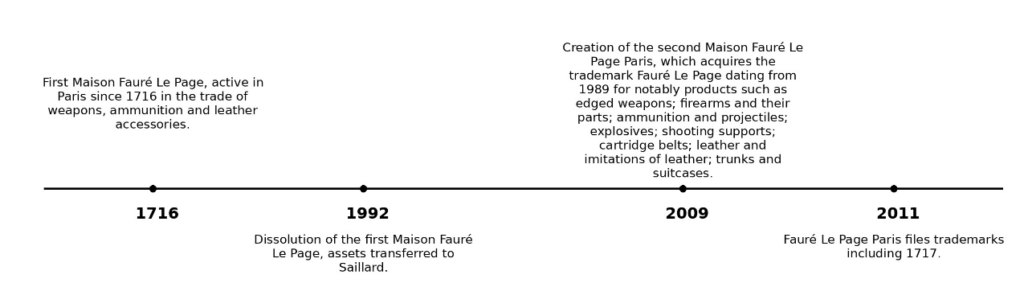
By way of background: an “original” Maison Fauré Le Page[2], active in Paris since 1716 in the trade of weapons, ammunition and leather goods, was dissolved in 1992, with its assets subsequently transferred to the company Saillard.
A “second” Maison Fauré Le Page Paris, established in 2009, acquired the trademark “Fauré Le Page”, dating back to 1989[3], for goods that include “side arms; firearms and their parts; ammunition and projectiles; explosives; shooting supports; cartridge belts; leather and imitations of leather; trunks and suitcases”.
In 2011, Fauré Le Page Paris filed trademarks for [4]
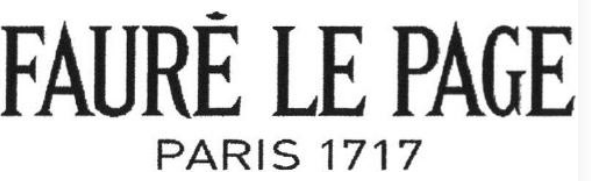
and

to designate, in particular, “leather and imitations of leather; trunks and suitcases; travelling bags; handbags”. These registrations are at the heart of the dispute.
Maison Goyard [5], “trunk maker since 1853”, challenged the validity of two French trademarks incorporating the date “1717”, on the grounds of their “allegedly deceptive character”.
On remand in 2021, the Paris Court of Appeal declared the contested marks invalid “on the basis of a serious risk of misleading the consumer”.
A further appeal on a point of law (“pourvoi”) was lodged, and the Court of Justice of the European Union was requested by the French “Cour de cassation” to give a preliminary ruling on the interpretation of Article 3(1)(g) of Directive 2008/95/EC, which provides that the following shall not be registered or, if registered, shall be liable to be declared invalid: (g) […] trade marks which are of such a nature as to deceive the public, for instance as to the nature, quality or geographical origin of the goods or service’”.
This provision does not refer to deception relating to the applicant itself. Rather, deception must be intrinsic to the goods designated by the trademark. What, then, of a date? Can it be connected to the characteristics of the goods covered by the mark?
The Court of Justice adopts a pragmatic (arguably expansive?) approach. It takes into account the sector at issue (luxury leather goods), as well as the fact that the claimed date (1717), when combined with a reference to Paris, is likely to be perceived as indicating the proprietor’s year of establishment. This, in turn, may lead the relevant public to infer a certain level of quality, as such a claim contributes to an image of longstanding know-how, craftsmanship and prestige associated with the luxury goods at stake:
“where a trade mark includes a number which is likely to be perceived by the relevant public as indicating the year of establishment of a business and evokes, because that year is in the distant past, long-standing know-how bestowing a perceived guarantee of quality and a prestigious image on the goods for which the mark is registered, even though no such long-standing know-how actually exists, it may be inferred that that mark is of such a nature as to deceive the public, within the meaning of that provision.”
The final chapter of this case remains to be written and now lies with the French “Cour de cassation”; in the meantime, the practical takeaway is clear: caution is required. Careful due diligence should be carried out when acquiring historic assets, particular attention should be paid to what may legitimately be used or registered, and the associated brand narrative should be handled with care.
Our teams are available to assist and advise you in auditing rights you intend to acquire, as well as throughout their lifecycle (filings, communication, enforcement, etc.).
[1] https://eur-lex.europa.eu/legal-content/EN/TXT/?uri=CELEX:62024CJ0412
[2] https://faurelepage.com/fr/pages/a-propos
[3] https://data.inpi.fr/marques/FR1534660?q=#FR1534660
[4] https://data.inpi.fr/marques/FR3839811?q=#FR3839811, https://data.inpi.fr/marques/FR3839809?q=#FR3839809
[5] https://www.goyard.com/eu_fr/
Article wrote by
Hélène Lecornu
May 2026