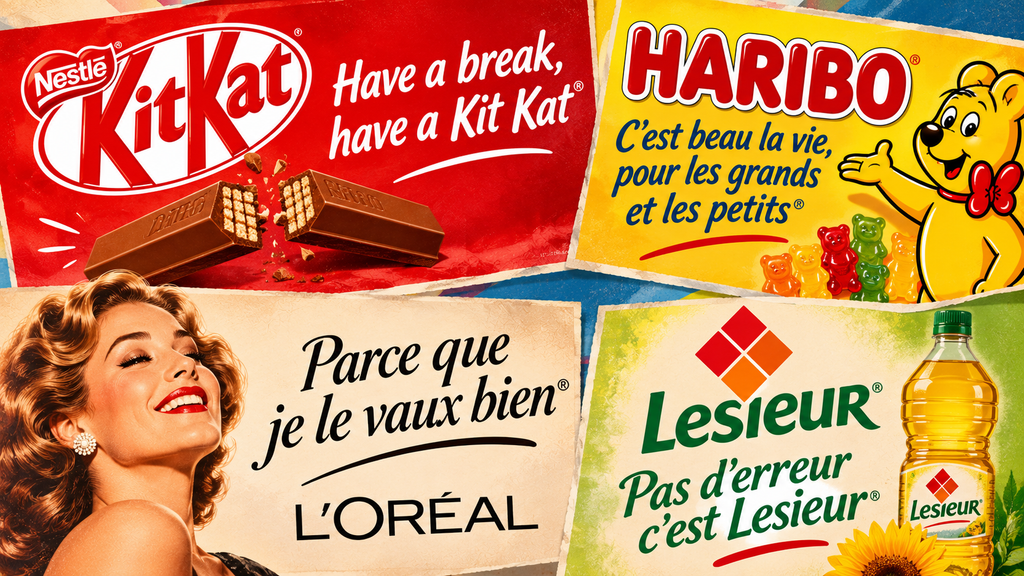
« Have a break, have a Kit Kat ® »
« Deux doigts coupe faim ® »
« Haribo c’est beau la vie, pour les grands et les petits ®»
« La vache qui rit ®»
« Parce que je le vaux bien ®»
« A fond la forme ®»
« Fraîcheur de vivre ® »
« Pas d’erreur c’est Lesieur ® »
So many slogans that bring a smile, and sometimes a touch of nostalgia. These slogans work like a “madeleine de Proust” for forty-somethings, having accompanied several generations of French consumers.
These short catchphrases are intended to attract the consumer’s attention and to set the product apart from the competition. They serve to guarantee a commercial origin for the public, which will draw a direct link between the slogan and its author.
In this context, slogans meet the definition of a trade mark when they serve to distinguish the goods or services of a natural or legal person from those of other natural or legal persons (Article L.711-1 of the French Intellectual Property Code).
Nevertheless, not all slogans can constitute valid trade marks, and this is the case where the slogan chosen comes up against the criteria of protection laid down by the Intellectual Property Code and, in particular, the provisions of Article L.711-2, which states that:
“The following may not be validly registered and, if registered, are liable to be declared invalid:
1° Signs which cannot constitute a trade mark within the meaning of Article L.711-1;
2° Trade marks devoid of distinctive character;
3° Trade marks consisting exclusively of elements or indications which may serve, in trade, to designate a characteristic of the goods or services, and in particular the kind, quality, quantity, intended purpose, value, geographical origin, or the time of production of the goods or of rendering of the service;
4° Trade marks consisting exclusively of elements or indications which have become customary in the current language or in the bona fide and established practices of the trade…”
This control is exercised by administrative authorities such as the French National Institute of Industrial Property (INPI) and the European Union Intellectual Property Office (EUIPO) in the course of their examination of the trade mark application.
The most common ground of rejection rests on the fact that the trade mark applied for would be perceived as exclusively promotional information tending to highlight the positive characteristics of the goods and/or services, and not as an indication of their commercial origin.
By way of illustration, the following signs did not successfully clear the examination stage:
- TAKE YOUR TIME PAY AFTER for services in Class 36 (bank card, credit and debit card services) – General Court of the European Union, T-755/16;
- MORE THAN JUST A CARD for services in Class 36 (bank card, credit and debit card services) – EUIPO Board of Appeal, R 1608/2007-4 ;
- WE PUT YOU FIRST AND KEEP YOU AHEAD for services in Class 40 (treatment of materials);
- SAVE OUR EARTH NOW for services in Classes 3, 17, 18, 20, 22, 24, 25 and 28 – EUIPO Board of Appeal, R 1198/2008-4 ;
- DREAM IT, DO IT ! for services in Classes 35, 36, 41 and 45 – General Court of the European Union, T-186/07 ;
- DRINK WATER, NOT SUGAR for services in Classes 32 and 33 (alcoholic and non-alcoholic beverages) – EUIPO Board of Appeal, R 718/2007-2 ;
Nevertheless, the Court of Justice of the European Union has provided guidance which should be followed when assessing the distinctive character of a slogan (21 January 2010, Audi v OHIM, C-398/08 P, “Vorsprung durch Technik” meaning “advance through technology”; EU:C:2010:29, § 47; 13 April 2011, T-523/09, “Wir machen das Besondere einfach” meaning “We make the exceptional simple”, EU:T:2011:175, § 37).
In the light of that case law, an advertising slogan is liable to possess distinctive character where it is perceived as being more than a mere advertising message praising the qualities of the goods or services concerned, because it:
- Constitutes a play on words, or is made up of unusual syntactic structures, or
- Introduces elements of conceptual tension or surprise, such that it may be perceived as imaginative, surprising or unexpected, or
- Possesses a particular originality or resonance, or
- Triggers in the relevant public a cognitive process or an effort of interpretation through the use of linguistic and stylistic devices such as alliteration, metaphor, rhyme, paradox, etc.
Moreover, in accordance with settled case law of the General Court of the European Union, a slogan whose meaning is vague or impenetrable, or whose interpretation requires a significant intellectual effort on the part of the relevant consumers, is also liable to possess distinctive character, since those consumers will not be able to establish a clear and direct link with the goods and services for which the mark is protected.
It should also be noted that a slogan is liable to constitute a valid trade mark where it has acquired distinctive character as a result of intensive use by the public. Thus, it has been held that the sign RENT A CAR, filed in particular for vehicle rental services, is “clearly identified by French driving licence holders as a car rental brand and is among the best-known car rental brands for them” (French Supreme Court, Commercial Chamber, 7 July 2021, No. 19-16.028).
In summary
A slogan can constitute a competitive advantage and an undeniable marketing asset when it is able of being perceived by the public as an indication of origin, and not as a mere laudatory or advertising formula, which must accordingly remain free for all to use.
The proprietor of a slogan registered as a trade mark may exercise its rights by acting on the basis of infringement against an identical or similar later sign where a likelihood of confusion may result.
In addition, it should be noted that the proprietor of a slogan is in a position to claim copyright provided that the slogan displays a sufficient degree of originality. The assessment of that criterion falls within the sovereign discretion of the courts.
Beyond actions brought on the basis of trade mark infringement and/or copyright, the proprietor of a slogan would be in a position to base its claims on unfair competition and/or parasitism.
These various forms of protection may be combined within the same proceedings, provided that distinct acts are established.
A distinctive and original slogan therefore provides its proprietor with legal weapons to deploy against malicious competitors.