
462 million euros. That is the amount of the fine imposed by the European Commission on the pharmaceutical group Teva in October 2024, the largest ever handed down in a case of abuse of dominant position in the pharmaceutical sector. The cause: a comprehensive protection strategy around Copaxone, Teva’s flagship drug indicated for the treatment of multiple sclerosis. A strategy which, according to the Commission, went beyond the limits of competition law.
How did it come to this?
A seemingly legitimate strategy… but pushed too far
The case began in 2019, when the European Commission turned its attention to Teva’s practices suspected of being anticompetitive in the markets for glatiramer acetate, the active substance in Copaxone, in the treatment of multiple sclerosis. The investigation concerned seven Member States: Germany, Belgium, Spain, Italy, the Netherlands, Poland and the Czech Republic.
Teva was at the time facing the arrival of Synthon GA, a glatiramer acetate-based medicine developed by the generic manufacturer Synthon, whose first marketing authorisations had been obtained in 2016. According to the Commission, Synthon GA was the only generic-like alternative to Copaxone in Europe.
In this context, the Commission carried out unannounced inspections at several Teva premises. It also sent requests for information to Teva, to its competitors, and to health authorities and health insurance bodies.
The investigation then focused on the comprehensive strategy implemented by Teva around Copaxone, referred to internally under the name “Copaxone Continuation Project”. This strategy, managed centrally and extensively documented, aimed to preserve the commercial exclusivity of Copaxone after the expiry, in 2015, of the primary patent, in the face of the arrival of the competing product Synthon GA.
According to the Commission, this strategy relied on several complementary pillars: an abusive use of the divisional application system, a disparagement campaign directed against Synthon, as well as an active conversion of patients towards the 40 mg formulation, protected by new patents.
First abuse: the “divisional game“
Teva had protected Copaxone with a primary patent on the composition of glatiramer acetate, which expired in 2015. As this deadline approached, it filed secondary patents (on a manufacturing process and on a new dosage regimen), then multiplied divisional applications derived from these families, with claims that the Commission considered to be largely overlapping.
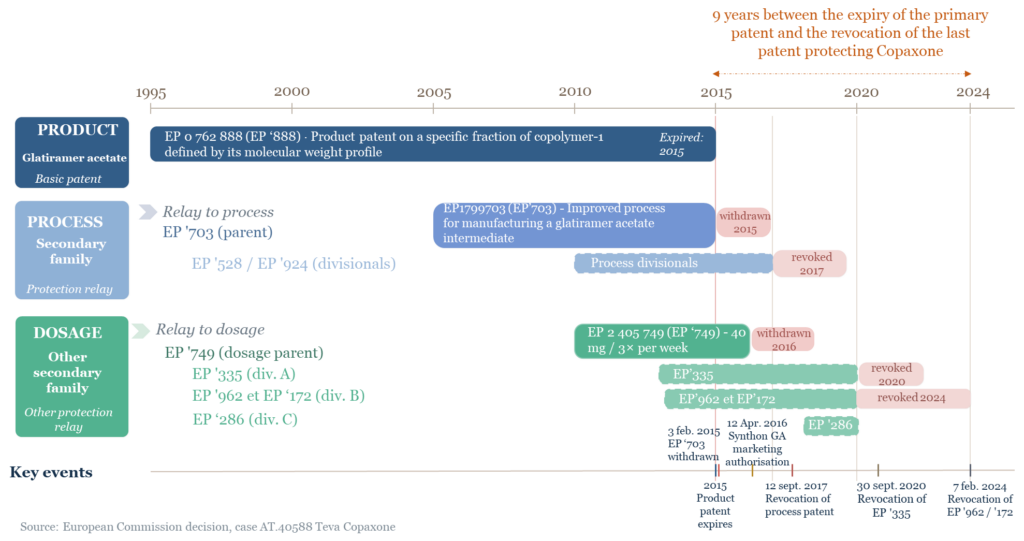
A divisional application is an application filed from a parent application still pending before the EPO. It takes on the initial filing date and does not formally extend the duration of protection (twenty years from the date of filing). Its interest is procedural: each divisional opens a new examination procedure, then an opposition period and, where applicable, appeal proceedings. Staggered filings thus allow a family to remain active for several years, even after revocation of the parent patent.
The Commission considered that Teva had used this mechanism in an abusive manner: the staggered filings allowed it to have a new title available when an older title was threatened with revocation.
At the same time, Teva systematically withdrew its approval of the text of the contested patents shortly before any decision on the merits in opposition or appeal proceedings before the EPO. With no text on which to rule, the EPO revoked the patent, but without reasoned grounds capable of being invoked against the remaining titles in the family. Competitors thus found themselves compelled to restart the challenge title by title, each time with new timelines and new costs.
In practice, according to the Commission, this strategy contributed to maintaining legal uncertainty for several years after the expiry of the primary patent, with the last facts relied on dating from 7 February 2024, the date on which the last relevant divisional patents were revoked. Teva also relied on these patents to initiate litigation and seek preliminary injuctions against its competitors, turning its patent portfolio into a lever for commercial exclusion.
Second abuse: the disparagement campaign
In parallel, Teva disseminated to doctors, pharmacists, payers and health authorities messages presented as scientific, but considered objectively misleading by the Commission, aimed at casting doubt on the safety, efficacy and therapeutic equivalence of Synthon’s product, despite its marketing authorisation. This campaign was conducted from April 2016 until different dates depending on the Member States concerned (and lasted October 2020 in Italy), constitutes the second limb of the infringement.
The two abuses were characterised as a single and continuous infringement under Article 102 of the Treaty on the Functioning of the European Union, on the grounds that they pursued a common objective: to delay or prevent the entry and development of the sole competitor in the markets concerned.
And in practice?
The decision does not call into question the right to file divisional applications, nor the right to defend one’s patents. It recalls that patent law does not constitute a zone of immunity from competition law, and that it is the combination of practices — such as staggered filings, strategic withdrawals, contentious proceedings, disparagement — that gives rise to the characterisation of abuse.
For patent holders, the main lesson is to document the technical and strategic purpose of each divisional filing, to avoid filings whose claims overlap without justification, to exercise caution with withdrawals during proceedings, and to strictly frame communications relating to competing products.
For competitors, the case underlines the value of a comprehensive approach: mapping the patent family, coordinating EPO oppositions and actions before national courts, and documenting the concrete effects on market entry. The unitary patent and the UPC now offer a centralised revocation lever, without however eliminating the risk linked to divisional families.
The decision is not final: Teva brought an action for annulment before the General Court of the European Union on 15 January 2025 (T-19/25). Furthermore, generic manufacturers are now reproaching GSK for a similar strategy surrounding certain patents relating to the Ellipta treatment, confirming that the “divisional game” has become a topic of vigilance for the pharmaceutical sector.
Our intellectual property advisory team supports companies in the analysis and safeguarding of their patent strategies. Do not hesitate to contact us.
May 2026
Contributing author