

Because a trademark’s purpose is to enable the identification of goods and/or services, the law granted to its owner survives only insofar as the mark is actually used in that manner.
Exploitation of registered signs is therefore necessary to maintain their rights. If a mark is not used for an uninterrupted period of 5 years, the proprietor may have their trademark rights revoked for non-use.
This rule reflects legislators’ intent to free up signs that are needlessly reserved (i.e. not used) and thereby reduce congestion in the trademark registers!
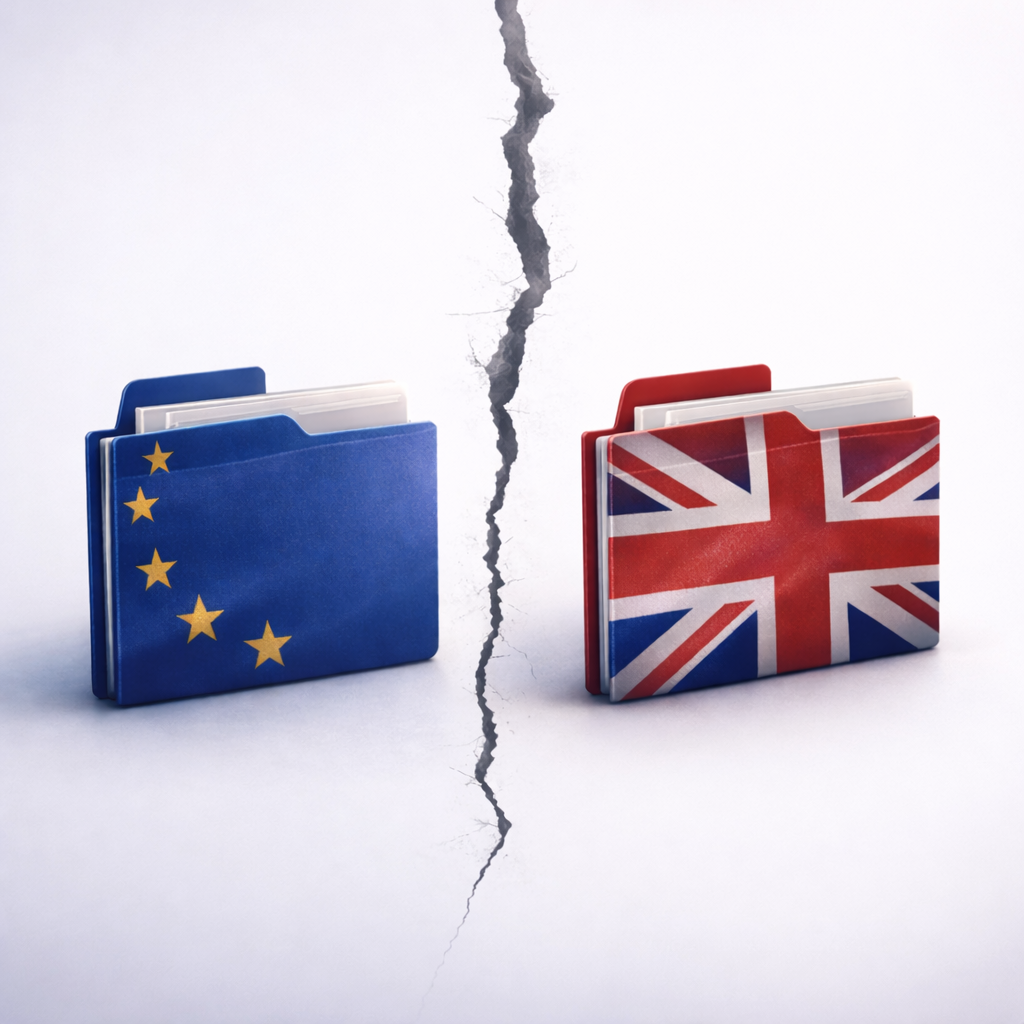
In the United Kingdom, as of 1 January 2026, European Union trademarks, cloned following Brexit, risk revocation for non‐use.
Indeed, until 31 December 2025 there was a transition period allowing holders of cloned trademarks in the UK to avoid a revocation request for non-use by relying on use of the mark within European Union territories—even if there had been no use in the UK.
From 1 January 2026, in the UK only effective and serious use within that territory will allow holders of cloned trademarks to escape revocation for non-use.
I. Origin and Legal Mechanism of Cloned Trademarks.
As you may recall, before Brexit, European Union trademarks (EUIPO) were automatically protected in all Member States, including the UK.
But following Brexit, the UK ceased to be covered by EU trademark protection. Thus, on 1 January 2021, the UK Intellectual Property Office (IPO) automatically converted all valid EU trademarks at that date into an equivalent UK trademark known as a comparable UK trade mark.
That cloning took place without formalities or initial cost, preserving filing and priority dates, and where relevant, claimed seniorities.
An exceptional measure was introduced for these British “cloned” marks. During the transition period of 2021-2025, use of the mark in the European Union was accepted as valid “use” in the UK for defending cloned marks against revocation actions for non-use. This was the case even if there had been no use in the UK itself.
II. 1 January 2026: What Actually Changes.
We now come to the end of that transition. As of 1 January 2026, use in the EU will no longer be admitted to satisfy the use requirement of British “cloned” trademarks for the previous five-year period to avoid revocation. Only use within the UK during that period will be taken into account.
This coincides with the fact that 1 January 2026 marks the expiry of the five years since the creation of Comparable UK marks. In other words, the “grace period” permitting reliance on EU use ends.
III. Effects for the Holders
The main risk is revocation for non-use: a third party may ask the UK Intellectual Property Office to remove the mark from the register if it has not been used for an uninterrupted period of five years in the UK.
This risk is especially high because many holders are unaware of the existence of these cloned marks. Indeed, since the cloning was automatic and required no formality, some holders have continued to think in “European Union” logic, often mistakenly: the cloned marks existed legally, but with no specific use in the UK.
Thus, holders of cloned trademarks who have never used their marks in the UK (for some or all of the goods/services registered) face potential partial or total revocation actions starting from that date. Further, non-used cloned trademarks will not serve effectively as prior rights in oppositions or litigation.
In case of revocation, the mark ceases to exist for the goods/services concerned and the owner loses the right to oppose or invalidate later trademarks.
IV. What Strategies to Adopt?
It is strongly recommended to conduct portfolio audits to verify whether cloned trademarks are actually and effectively used for all the goods/services in the UK territory.
If not, one should, as far as possible, undertake qualitative use (advertising, packaging, distribution, localized digital marketing) of the mark and collect proof of use (photographs, invoices issued in the UK, advertising material, contracts, presence in stores, online captures: always dated and demonstrating the UK territory concerned).
Auditing portfolios and rethinking the UK’s role in trademark strategy are no longer optional: they are imperatives.
Our team is at your disposal to assist you with your strategy in this territory.
Février 2026


February 2026