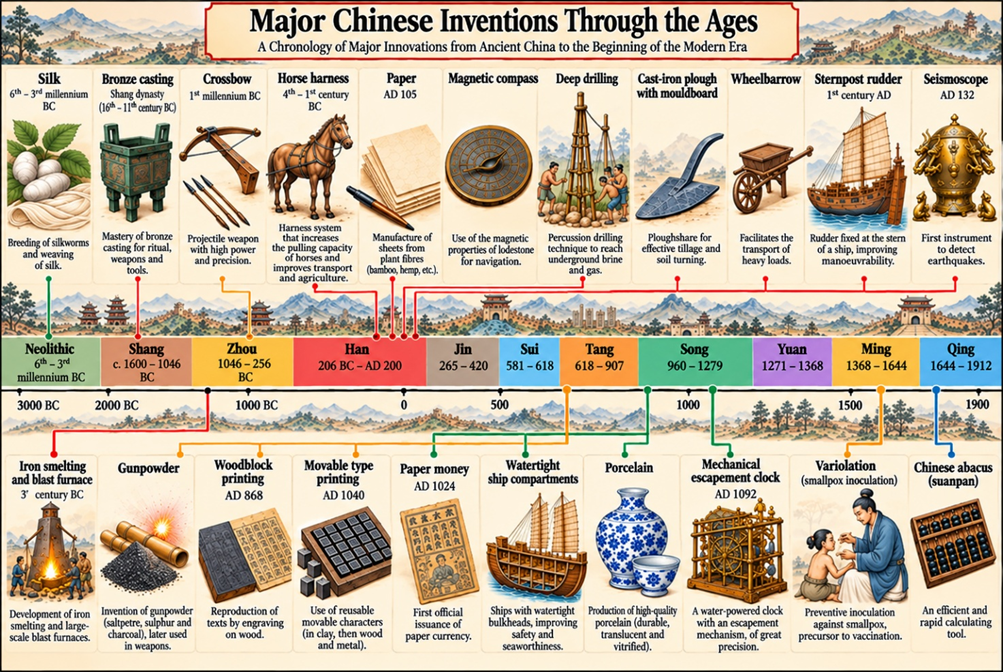
For more than two millennia, from the Zhou dynasty to the fall of the Qing dynasty in 1912, China was the birthplace of major innovations in fields as diverse as agriculture, metallurgy, navigation, medicine and communications. The major ones are listed below :
1. Paper
Before the invention of paper, the Chinese wrote on bamboo strips, wooden tablets or silk, materials that were either heavy or expensive. In AD 105, during the Han dynasty, Cai Lun refined a process using plant fibers dispersed in water, then drained, pressed and dried to form lightweight, flexible sheets. However, earlier forms of paper had already existed as far back as the 2nd century BC. Gradually spreading through Central Asia and the Middle East, paper reached Europe in the 12th century, where it became essential to the development of printing and the dissemination of knowledge.
2. The Magnetic Compass
The magnetic properties of lodestone were known in China as early as antiquity. During the Han dynasty, a device known as the Sinan used a magnetized spoon resting on a marked plate. This subsequently evolved into compass needles, sometimes floating on water. During the Song dynasty (10th–12th centuries), the compass was adapted for maritime navigation, allowing sailors to maintain their course without relying on celestial observations or coastal landmarks. It reached Europe towards the end of the 12th century and contributed significantly to the development of long-distance maritime exploration.
3. Gunpowder
Discovered by Taoist alchemists during the Tang dynasty (7th–9th centuries), gunpowder resulted from combining saltpeter, sulphur and charcoal. Initially used in incendiary devices, it subsequently enabled the development of grenades, rockets, fire lances and early cannons. Introduced into Europe in the 13th century, gunpowder profoundly transformed warfare, particularly by making medieval fortifications vulnerable to artillery.
4. Printing
As early as the 7th and 8th centuries, Chinese craftsmen developed woodblock printing, enabling multiple copies of a text to be reproduced from engraved wooden blocks. The Diamond Sutra, dated AD 868, is one of the oldest surviving printed books. Around 1040, Bi Sheng invented movable type made from fired clay, allowing individual characters to be reused to compose different texts. Wang Zhen subsequently improved the technique using wooden characters. These innovations facilitated the dissemination of religious, scientific and administrative texts, several centuries before Gutenberg developed printing technology in Europe.
5. Sericulture and Silk Production
Gradually mastered during the Neolithic period, silk production involved breeding silkworms, unwinding their cocoons and weaving the resulting filaments. This complex process combined biological knowledge, materials processing and industrial organization. Silk became one of the most sought-after commodities in Eurasia, giving its name to the famous trade routes connecting China with the West.
6. Bronze and Iron Casting
As early as the Shang dynasty (1600–1046 BC), Chinese craftsmen had mastered bronze casting using sectional molds, enabling the production of intricately shaped objects. From the Warring States period onwards, they developed blast furnaces capable of producing molten iron at high temperatures. Cast iron could therefore be poured directly into molds to mass-produce agricultural tools, weapons and various other items, long before these techniques became widespread in Europe.
7. Porcelain
During the Tang dynasty, Chinese potters perfected the production of vitrified ceramics using kaolin and feldspathic rocks, fired at temperatures exceeding 1,200°C. Impermeable, translucent and durable, porcelain became a prestigious export product, particularly during the Song and Ming dynasties. European manufacturers did not succeed in reproducing comparable hard-paste porcelain until the early 18th century, in Meissen.
8. Deep Drilling
During the Han dynasty, engineers in Sichuan developed percussion drilling techniques using metal tools suspended from bamboo cables. These installations made it possible to reach underground brine deposits at considerable depths. Extracted natural gas was also transported through bamboo pipelines and used as fuel, anticipating certain modern drilling and energy-extraction techniques.
9. The Horse Harness
Between the 4th and 1st centuries BC, the Chinese developed the breast collar harness and subsequently the rigid horse collar, transferring pulling forces to the animal’s shoulders and skeletal structure rather than its throat. These devices considerably increased horses’ pulling capacity and, following their introduction into Europe, contributed to the development of land transport and agriculture.
10. The Cast-Iron Moldboard Plough
Used as early as the 3rd century BC, the Chinese cast-iron ploughshare, combined with a curved moldboard, could penetrate deeply into the soil and turn it over. This innovation improved soil aeration, reduced weeds and increased agricultural productivity. Comparable techniques subsequently contributed to the transformation of European agriculture.
11. The Wheelbarrow
Documented during the Han dynasty, the Chinese wheelbarrow generally positioned its wheel beneath the load, considerably reducing the effort required for transportation. This mechanical principle enabled a single person to move substantial loads. The wheelbarrow appeared in Europe during the Middle Ages, particularly in the 13th century.
12. The Sternpost Rudder
As early as the 1st century AD, Chinese shipbuilders used rudders mounted vertically at the stern of vessels, replacing traditional lateral steering oars. This device improved the maneuverability of large ships. Its spread to Europe during the Middle Ages contributed to the development of ocean-going navigation.
13. Watertight Ship Compartments
Chinese junks featured bulkheads dividing their hulls into watertight compartments. This design limited the consequences of hull damage, reinforced the vessel’s structure and facilitated cargo storage. The principle remains fundamental to modern shipbuilding.
14. Zhang Heng’s Seismoscope
In AD 132, Zhang Heng designed an instrument to detect earthquakes. An internal mechanism triggered the release of a bronze ball from one of eight dragons arranged around a bronze vessel, indicating the presumed direction of the earthquake. This device demonstrated the possibility of mechanically detecting natural phenomena that were otherwise difficult to perceive.
15. The Mechanical Escapement Clock
In 1092, Su Song constructed a remarkable hydraulic clock tower in Kaifeng, using an escapement mechanism to regulate the movement of an armillary sphere and devices indicating the hours. This invention represented an important milestone in the history of mechanical timekeeping.
16. The Crossbow
Known since the Warring States period, the Chinese crossbow was distinguished by its sophisticated metal trigger mechanisms, which could hold a highly tensioned bowstring and release it precisely. Chinese craftsmen also developed repeating crossbows capable of firing several projectiles in succession.
17. Variolation
Between the Song and Ming dynasties, Chinese physicians developed inoculation practices intended to protect against smallpox, particularly by introducing material collected from infected patients into the nostrils of healthy individuals. Gradually spreading to other parts of the world, variolation preceded the development of modern vaccination by Edward Jenner in 1796.
18. Paper Money
During the Song dynasty, in the 10th and 11th centuries, merchants in Sichuan began using deposit receipts to avoid transporting large quantities of heavy metal coins. The government officially introduced paper currency in the early 11th century. This financial innovation preceded the appearance of the first European banknotes by several centuries.
19. The Chinese Abacus
The suanpan, refined particularly during the Ming dynasty, used a system of movable beads to perform additions, subtractions, multiplications, divisions and more complex calculations rapidly. An essential instrument for commerce and administration, it illustrates Chinese ingenuity in the field of calculation.
The Modern Era and Future Perspectives
These inventions illustrate the extraordinary richness of China’s scientific and technological heritage. Many resulted from centuries of experimentation, combining craftsmanship, mastery of materials and the search for practical solutions.
After a period of relative technological decline, China revived this tradition towards the end of the 20th century. The adoption of its first Patent Law in 1984 marked a decisive step towards establishing a modern intellectual property system. Since then, government policies have placed innovation at the heart of industrial development, leading to spectacular growth in patent filings by Chinese applicants, both domestically and internationally.
In 2025, with 73,718 international patent applications filed under the Patent Cooperation Treaty (PCT), China ranked first worldwide, ahead of the United States and Japan.
Discover our white paper on the legacy of China’s great inventions and the challenges of contemporary innovation by clicking here.
November 2026
Contributing author